

EMBEDDING RESILIENCE ACROSS A GLOBAL ORGANISATION
AB WORLD FOODS
How It Started
AB World Foods is a global food manufacturing organisation behind some of the UK's best-loved brands — Blue Dragon, Patak's and Levi Roots among them. The business operates with a deliberate cultural philosophy of "High Challenge and High Support" — a combination that creates energy and ambition, but also places real demands on its people.
The conversation with Russell began not through a procurement process or a formal tender. The Global HR Director listened to The Resilience Coach Podcast, heard something that resonated, and tasked her People and Reward Director with bringing Russell into the business.
That backstory matters. This was not a box-tick exercise commissioned by committee. It was a leader who recognised something her people needed — and acted on it.

The Brief
The People and Reward Director was refreshingly clear from the outset: the business was not primarily looking for a return on investment measured in financial terms. What AB World Foods wanted was different, and arguably more important — a genuine improvement in their people's understanding of Resilience, and the confidence to role model it personally and as a leader.
This reflected the "High Challenge and High Support" culture. A business that pushes its people hard has a responsibility to equip them to sustain that level of performance. Resilience wasn't a nice-to-have. It was a strategic enabler.
The Scope of Work
Russell designed and delivered a multi-layered programme spanning three distinct levels of intervention:
| Programme | Format | Focus |
|---|---|---|
| Introduction to Resilience (x4) | 60-min Webinar, 50+ per session | The Resilience Wheel — broad introduction. Recorded and hosted internally for on-demand access. Potentially reaching thousands. |
| Personal Resilience (x5) | 2-hour Virtual Workshop, 15 per session | Deep dive into the Resilience Wheel. Personal application. Actionable behaviour commitments. |
| The Resilient Leader (x3) | 2-hour Virtual Workshop, 12 per session | The Resilience Wheel from a leadership perspective. The 6 things leaders need to role model in a Resilient Organisation. |
In addition to the group programme, Russell was asked to take on two individual coaching clients — a Finance Director and a Marketing Director — each engaged on a 9 to 10-month coaching programme. A follow-up wellbeing-focused workshop series was also delivered for a specific ABWF site at a later date.
In total, the Introduction to Resilience webinars were recorded and provided to AB World Foods to host on their internal platform — meaning the reach of the programme extended well beyond the live sessions to potentially thousands of employees who could access the content at any time.
The Foundation: The Resilience Wheel
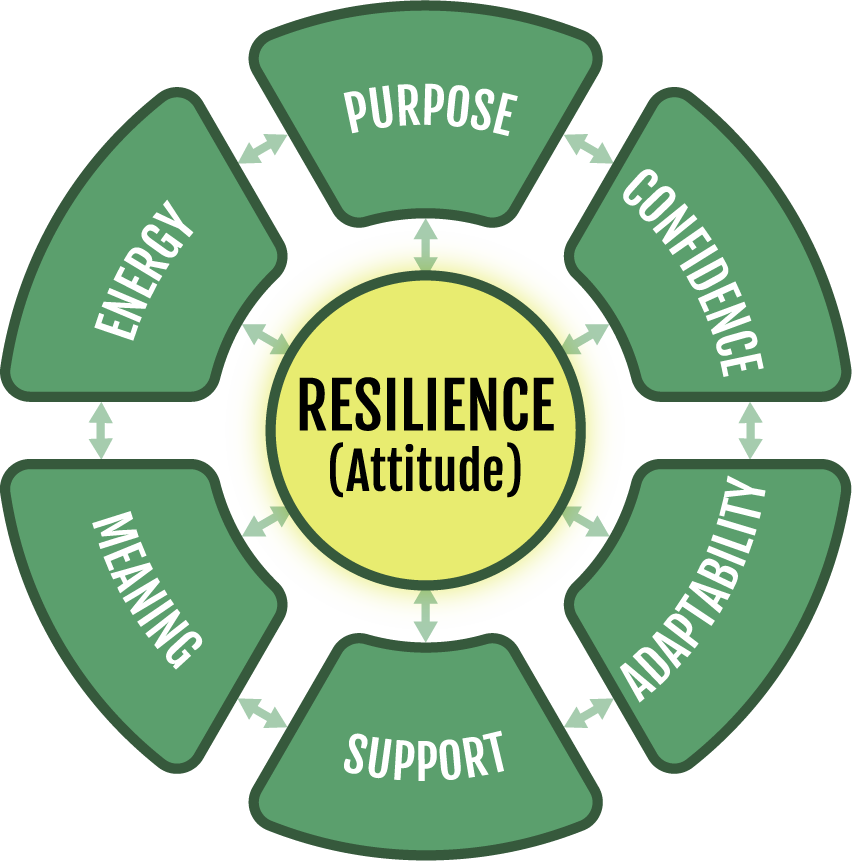
Every session - regardless of level - was anchored in The Resilience Wheel: Russell's evidence-based framework for understanding and building personal resilience. The seven dimensions of the Wheel gave participants a common language and a practical structure for self-assessment and development.
The seven dimensions, and how ABWF participants ranked them across the Personal Resilience sessions:
Attitude - ranked #1 most frequently (participants most aware of its impact)
Adaptability - consistently ranked #2
Energy - #3 (strong awareness of energy as a resilience driver)
Support Network - #4 (recognised but underutilised)
Confidence - variable ranking, often flagged as a development area
Purpose - frequently cited as a personal development priority
Meaning - lowest ranked, though consistently referenced in action plans
How Participants Defined Resilience: Before and After.
One of the most revealing aspects of the evaluation data is the shift in how participants described resilience — from the start of each session to the end. This is the centrepiece of Russell's approach: not just teaching about resilience, but changing how people relate to it.
Starting Definitions — What Resilience Meant Before:
At the start of sessions, participants' descriptions of resilient people were dominated by fixed, trait-based language. Resilience was something you either had or didn't:
"Strong" - the single most common word across all 12 sessions
"Adaptable" - high frequency across all session types
"Positive" / "Optimistic" - consistent across introductory sessions
"Tough", "thick-skinned", "bouncebackability", "gritty" - resilience as armour
"Determined", "persistent", "keep going" - resilience as endurance
"Confident", "self-aware" - resilience as self-possession
The pattern is clear: at the start, people conceptualised resilience as a quality — something you are, rather than something you do or develop. Many of the words carry an implicit assumption that resilience is fixed and innate.
Closing Definitions - What Resilience Meant After:
By the end of sessions, the language had shifted meaningfully. The static trait words gave way to active, growth-oriented language:
"Springing forward with learning" - Russell's own definition, adopted verbatim by one participant and echoed by others
"Balanced" - appearing frequently in closing word clouds, replacing "tough"
"Purposeful" / "grounded by their purpose" - purpose-based language emerging
"Selful" - a recurring word reflecting Russell's framework around self-care
"Always learning" - growth mindset language appearing at the close
"Making a choice every day" - resilience as agency, not trait
"Thriving" - the aspirational goal, rather than just surviving
"Empowered", "energised" - active, forward-looking language
"Like me" and "hopefully me" - personal identification with resilience
That final pair is particularly significant. By the end of sessions, people were describing resilient people as people they saw themselves becoming - not a distant, heroic archetype, but something they could embody. That is the shift Russell's work is designed to create.

The Resilient Leader: How Leaders Described It.
The three Resilient Leader workshops produced their own distinct language. Leaders were asked "The Resilient Leader is...?" both at the start and end of each session. The evolution across the three workshops tells a clear story.
Opening descriptions across the three leader sessions:
Session 1 (16 May): "self-aware, adaptable, inclusive, compassionate, kind, connected, confident"
Session 2 (20 May): "balanced, adaptable, purposeful, empathetic, authentic, reflective, inspiring, holistic"
Session 3 (29 May): "reflective, balanced, clear, humble, a role model, bouyant, supportive, deal with uncertainty"
Closing descriptions — what shifted after the session:
Session 1: "inclusive, happy, autonomous, adaptable, a role model, compassionate" — "autonomous" notable new addition
Session 2: "optimistic (x4), authentic (x2), reflective, a good role model, able to coach others, energiser, intentional, leadership purpose" — coaching identity emerging strongly
Session 3: "purposeful, vulnerable, human, clear, authentic, brave, delegating wisely, enlightened, fostering psychological safety, open and honest"
The progression is striking. By the third session, leaders were describing the Resilient Leader in terms of specific observable behaviours - vulnerability, wise delegation, psychological safety, honesty. These are not soft aspirations. These are leadership practices.
Actionable Commitments: What People Said They Would Do:
The evaluation asked participants what they would do to develop their resilience going forward. Across all 12 sessions, the action commitments clustered into clear themes:
Personal Resilience Sessions - Top Action Themes
Pause and reflect — the single most common commitment across all sessions ("take time to pause, reflect and re-energise")
Define or clarify my purpose — cited in almost every session across both cohorts
Work through my Resilience Wheel — mapping current position and identifying development areas
Identify and use my tribe / support network — recognising and actively engaging energy-giving relationships
Focus on what went well, not just what went wrong — explicitly reframing the attentional bias towards failure
Move from surviving to thriving — language echoing Russell's framework directly
Discuss my Resilience Wheel with my line manager — taking the learning into workplace conversations
Bring the Resilience Wheel to high-performing team sessions
Resilient Leader Sessions — Top Action Themes
Role model resilient behaviours more consistently and visibly
Create psychological safety — specifically, creating space where people feel safe to grow and try new things
Get clear on my own leadership purpose and share it with my team
Delegate more consciously and clearly — including conscious delegation to play to strengths
Make time specifically to talk about resilience in 1-2-1s and team sessions
Verbalise resilience behaviours — name what they are doing and why
Watch my own sustainable working practices
Use the Resilience Wheel in team sessions and HPT (High-Performing Team) discussions
Bring servant leadership behaviours more consciously into practice

What Participants Said - Quotes from the Sessions
On what resilience means to them
“Springing forward with learning — not bouncing back!”
“Making a choice every day.”
“Being grounded by their purpose.”
“Shifting my mindset from surviving and coping to thriving.”
“Like me — and hopefully me.”
On the benefits of developing their resilience
“Sleep better, show up better for my family, my friends, my colleagues, my customers.”
“Being a lighthouse for others when seas are rough.”
“I will be able to grow from previous experiences and adapt easily with change.”
“Thriving, not surviving. Energy. Motivation.”
“More probability of delivering business strategy sustainably.”
“Business challenges are overcome faster and better.”
“A happier me and hopefully a happier, more successful business.”
On the benefits for AB World Foods
“Growth mindset is infectious.”
“ABWF will be better placed to respond to a rapidly changing world.”
“An engaged and thriving community.”
“Higher quality output and focus on the right things.”
“Better performance. Thriving, high-performing, valued teams.”
On developing resilience in their teams (Leaders)
“Creating psychological safe environments where people feel safe to grow and try new stuff.”
“Making time specifically to talk about Resilience in groups and individual conversations.”
“Role modelling resilient behaviours — and also promoting agency and creating your own purpose.”
“Getting back to role modelling better and providing more clarity with delegation.”
Net Promoter Signal: Would You Recommend This Session?
Every session ended with the same question: "I will recommend this session to others." The results were unambiguous.
100%
of participants said YES — they would recommend the session to others
Across all 12 sessions. Zero "No" responses. Zero "Not sure" responses (bar two isolated exceptions in a single session).

Individual Coaching: Finance Director and Marketing Director
Alongside the group programme, Russell worked with two ABWF Directors on a 9 to 10-month individual coaching engagement. Both were senior leaders navigating the demands of operating in a fast-moving global food business.
Chris Heyn, Director of UK World Foods Marketing at AB World Foods, provided the following account of his coaching experience:
“I’ve gained so much from working with Russell over the last six months. During this time, we’ve visited various elements of the resilience wheel, a framework which I’ve found really clarifying. When I embarked on the coaching programme I wanted to get clarity on my purpose, my reason for being. I’ve found the various conversations with Russell so illuminating and helpful in helping me crystalise what motivates me and drives me both professionally and personally. I feel reinvigorated as a result. I find Russell’s balance of listening while providing gentle challenge and thought provocation really works for me. He’s also a lovely person to spend time with and someone I’d highly recommend to others.”
Summary of Outcomes
12 sessions designed and delivered across three levels of intervention
250+ people engaged directly in live sessions across webinars and workshops
Potentially thousands more reached via internal hosting of recorded webinars
100% recommendation rate — every participant said they would recommend the session to others
Measurable shift in how participants defined resilience — from fixed trait language to active, growth-oriented language
Common language established across the organisation around the Resilience Wheel
Leaders identified Psychological Safety and Modelling Resilient Behaviours as their top two role modelling priorities
Sustainable Work Practices identified as the most under-resourced leadership behaviour — a valuable organisational insight
Actionable personal and leadership commitments generated in every session
Two senior Directors supported through 9 to 10-month individual coaching programmes
Follow-up wellbeing workshops delivered at a specific ABWF site
Programme originated entirely through podcast — demonstrating the reach and quality of Russell's thought leadership
READY TO MOVE FORWARD?
READY TO BUILD A RESILIENT CULTURE IN YOUR ORGANISATION?
Russell Harvey works with senior leaders, teams and organisations navigating change, pressure and uncertainty.